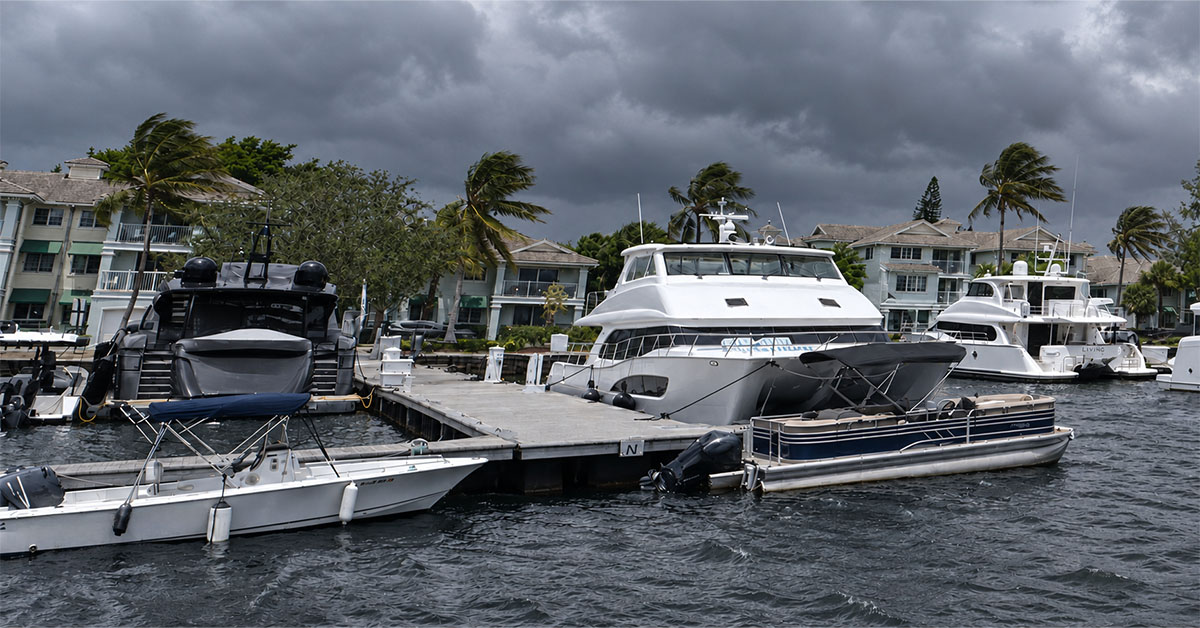
During storm events, dock lines function as the primary structural system securing a vessel against wind, surge, and tidal forces. The mechanics of line failure under peak storm loads are complex. Failure of a single line is rarely an isolated event. One snapped line alters the geometry of the entire docking setup, shifts the vessel’s angle, and initiates a chain reaction that escalates from localized strain to significant structural damage.
Analyzing the progression of dock line failure is essential for effective storm preparation. Technical variables including line condition, placement, chafe protection, and load distribution determine system performance during severe weather. Rigorous risk awareness ensures that docking setups are inspected based on engineering principles.
To visualize these principles in practice, refer to our Storm Docking Setup Diagram.
Dock Line Load Management and System Dynamics
In standard conditions, dock lines maintain vessel position, centering the boat within the slip to prevent contact with pilings or adjacent vessels. In storm conditions, these lines must absorb surge energy, resist high directional loads, and stabilize shifting vectors.
Bow and stern lines hold the boat’s position off the dock, keeping it centered and away from pilings. Spring lines are what actually control fore-and-aft surge, running at a shallow, lengthwise angle so the boat cannot lunge forward or aft with each wave. Breast lines pull the boat in close to the dock, limiting how far it can swing away. The integrity of the docking setup depends on balanced load distribution. When a line fails, the remaining components inherit forces they were not engineered or positioned to manage. This load transfer causes the characteristic cascade of storm-related failures.
Primary Points of Origin for Line Failure
Dock lines typically fail at identifiable high-stress points. Common failure origins include:
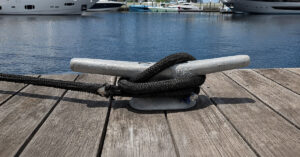
- Chafe at chocks, fairleads, and cleats
- Abrasion against dock corners, pilings, or rough hardware
- Overloading from wind and surge
- Shock loading from sudden jerks
- Old, UV-damaged, stiff, or poorly maintained rope
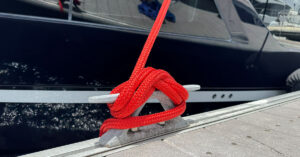
- Improper knots, bad splices, or weak attachment points
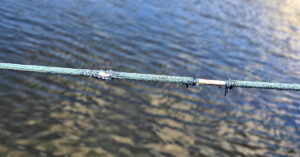
Storm conditions accelerate these degradation factors. Lines appearing sound in static conditions may harbor compromised fibers or internal structural damage. Peak gusts and repeated surges expose these vulnerabilities. Failure typically occurs at a localized friction point under high tension, where the combination of chafe, oscillation, and shock loading compromises the rope integrity.
Redistribution of Force Following Initial Failure
The failure of the first dock line results in an immediate redistribution of force across the system. For example, if a forward spring line parts, the vessel surges further aft with each wave cycle. This increases the tension on the stern line and remaining springs. The vessel begins to yaw, which pulls lines across edges that were previously clear of obstruction. A stable docking setup becomes unstable rapidly.
Common Failure Scenarios During a Storm
Docking failures during storms follow predictable technical patterns.
1. Vessel Pivot Dynamics
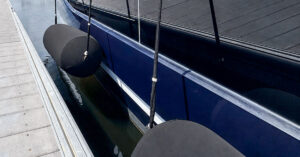
If a bow line fails, the stern remains secured while the bow swings. This pivoting motion alters the load vector on every remaining line. Forward restraints become side restraints, and spring lines are subjected to diagonal loads. Fenders often shift, exposing the hull to direct piling impact.
A pivoting hull is dangerous. Motion increases quickly as every gust adds momentum to the swinging mass.
2. Accelerated Surging Loads
Spring lines control longitudinal movement. If a spring line fails, the vessel lunges further than the system was designed to permit. This produces high-magnitude jerks on bow and stern lines, cleat overloads, and accelerated chafe at chocks. The increased travel distance results in higher shock loads when surviving lines reach their limit of extension.
3. Cumulative Chafe and Fiber Degradation
Prolonged oscillation cuts through dock lines fiber by fiber. This process often reaches a critical breaking point during the peak or late stages of a storm. At this stage, the system has already endured sustained strain, and the surviving lines are wet and fatigued. Effective storm preparation relies on robust chafe protection to mitigate these risks.
4. Displacement and Structural Impact
As docking geometry shifts, the vessel loses its centered position. This results in repeated impact with pilings, dock edges, and finger piers. Damage includes hull gouges, bent railings, and structural failure of deck fittings as the vessel grinds against dock infrastructure.
5. Multi-Vessel Involvement and Marina Risk
A compromised docking setup threatens the surrounding facility. A boat that breaks free can collide with adjacent vessels or cause the failure of shared dock hardware. This creates a chain reaction where docking components on multiple boats reach their ultimate tensile strength or shear limits.
6. Attachment Point and Hardware Failure
In many scenarios, the dock line maintains integrity while the attachment hardware fails. Deck cleats, dock cleats, fasteners, and pilings fail when loads exceed their rated capacity or occur at improper angles. Storm risk assessment must encompass the entire mechanical system, including rope, splices, backing plates, and structural pilings.
Systemic Consequences of Docking Failure
Docking failure results in severe vessel and infrastructure damage. Consequences include hull breach, crushed rub rails, fiberglass fractures, and bent pulpits. Infrastructure damage to finger piers and pilings occurs due to surging vessel mass. Drifting vessels pose a collision risk to fuel docks and neighboring boats, or may ground and become navigation hazards. Safety risks to personnel are significant. Snapped lines, failing hardware, and surging hulls create high potential for injury during storm intervention.
Technical Indicators of Imminent System Failure
System failure is often preceded by measurable indicators. High risk is signaled by lines reaching their limit of elasticity with zero shock absorption, repeated heavy surging, and visible fiber sawing at chocks. Physical evidence includes fenders displacing, vessel off-centering, and hardware flexing. Flattening, glazing, or fuzzing at contact points indicates advanced fiber degradation.
Engineering a Resilient Storm Docking Setup
Effective storm preparation focuses on preventing the initial failure to maintain system integrity. A resilient configuration requires appropriately sized lines in good condition, manufactured to Cordage Institute standards. Every chafe point must be protected, and lead angles should be optimized to avoid sharp turns. The system must maintain enough elasticity to absorb shock while limiting vessel travel. Regular inspection of cleats, chocks, and pilings is mandatory. Fenders must be strategically placed for probable contact zones.
Technical Conclusion
Dock lines are part of a complete mechanical restraint system. Failure of a single component forces a system-wide response that often leads to catastrophic collapse. Understanding these failure scenarios enables the engineering of a resilient docking setup capable of enduring the dynamic loads and shifting vectors characteristic of storm events.
FAQ: What Happens When Dock Lines Fail During a Storm
What usually causes dock lines to fail in a storm?
The most common causes are chafe, overload, shock loading, poor lead angles, worn rope, and weak hardware. In many cases, the line fails at a friction point rather than from pure tensile overload.
Can one failed dock line really cause multiple other lines to fail?
Yes. Once one line parts, the remaining lines often take on extra and differently angled loads. That change can increase chafe, shock, and strain, creating a chain reaction.
Which dock lines are most important during a storm?
All lines matter, but spring lines are especially important because they limit fore-and-aft surging. Without good spring control, shock loading on bow and stern lines increases quickly.
What happens if a boat is no longer centered in its slip?
It may begin striking pilings, docks, or neighboring boats. Fenders can move out of position, and the hull may take repeated impact or grinding damage.
Do dock lines always break before cleats or dock hardware fail?
No. Sometimes the line holds and the hardware gives way first. Cleats, bolts, backing plates, or pilings can all become the weak point.
Why is chafe such a major issue during storms?
Storm motion causes repeated rubbing under high tension. Even a strong line can wear through surprisingly fast if it is forced against a chock, cleat edge, piling, or rough dock corner for hours.
Is doubling up dock lines enough to prevent storm failure?
Doubling lines helps, but it is not enough by itself. The lines must also have proper lead angles, chafe protection, sound hardware, and balanced load distribution. Two badly routed lines can fail almost as easily as one.
Should boat owners try to adjust lines during the storm?
Only if it can be done safely and conditions allow it. Active storm conditions can make docks extremely dangerous. Surging boats, snapping lines, and failing hardware create serious injury risk.
Can dock line failure affect other boats in the marina?
Absolutely. A drifting or swinging boat can collide with neighboring vessels, overload shared dock structures, and trigger additional failures nearby.
What is the best way to reduce the risk of chain-reaction failure?
Use a full-system approach: strong and properly sized lines, redundant critical restraints, spring lines, chafe gear, inspected hardware, and storm-specific line arrangement designed to control movement rather than just restrain it.